Robotics
Chinese Automakers Expand Into Humanoid Robots as Car Margins Tighten
Xpeng, Chery, BYD and other Chinese automakers are expanding into humanoid robotics as intense competition compresses vehicle margins. Their manufacturing and supply-chain experience offers an advantage, but reliable manipulation, safety and deployment economics remain unresolved.
By Michael G ·
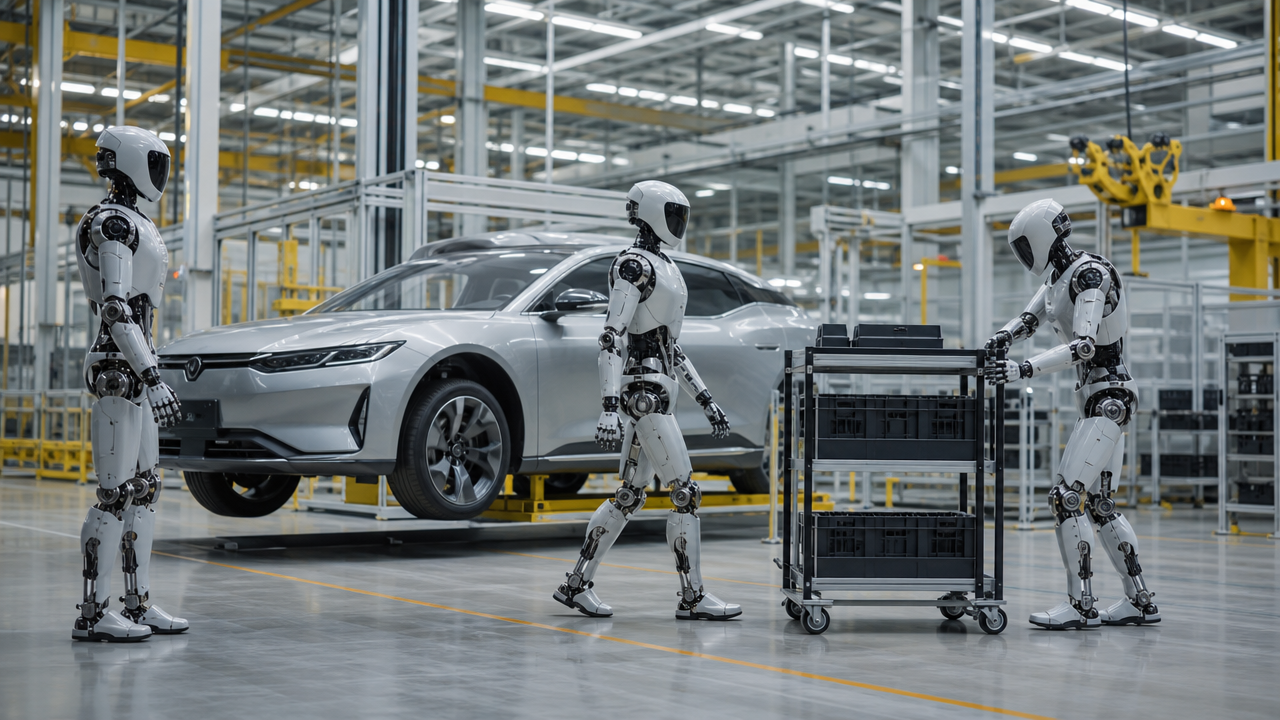
Chinese automakers are moving deeper into humanoid robotics as fierce competition pushes vehicle margins lower and companies search for products that can reuse their manufacturing, battery and autonomy expertise. Xpeng, Chery, BYD and several state-backed groups now have robot programs at different stages of development. The industrial logic is real: automakers understand motors, power electronics, sensors and complex supply chains. The technical leap is also easy to underestimate. A humanoid that performs safely through an entire factory shift is a less forgiving system than a prototype that completes a chore on video.
Xpeng has made the largest recent financial commitment. Its robotics unit raised more than $900 million at a post-money valuation above $6.3 billion, according to TechCrunch. The round was led by IDG Capital, with Gaorong Ventures, Tencent and Alibaba participating. Xpeng described the transaction as the largest single private financing round in China's embodied AI sector. Founder He Xiaopeng and co-president Brian Gu also invested about $100 million, according to the Wall Street Journal, aligning senior management directly with the outcome.
The company's central platform is Iron, a human-shaped robot intended for commercial work. That choice reflects the argument behind humanoids: factories, warehouses and service environments were designed around human reach, steps, tools and workstations, so a machine with a similar form may enter those spaces without rebuilding everything. The opposing argument is equally practical. Legs, dexterous hands and whole-body balance create failure modes that simpler mobile bases and fixed arms avoid. Human compatibility can become mechanical complexity.
Car Supply Chains Offer a Head Start
Automakers do have capabilities that many robotics startups must build from scratch. They source actuators, cameras, batteries and compute at scale. They operate validation labs, manage safety-critical software and know how to move a design from pilot tooling to repeatable assembly. Xpeng can also draw on years of autonomous-driving development, where perception systems must combine uncertain sensor data and act in real time. Those assets do not solve manipulation, but they shorten the path from a laboratory bill of materials to a manufacturable machine.
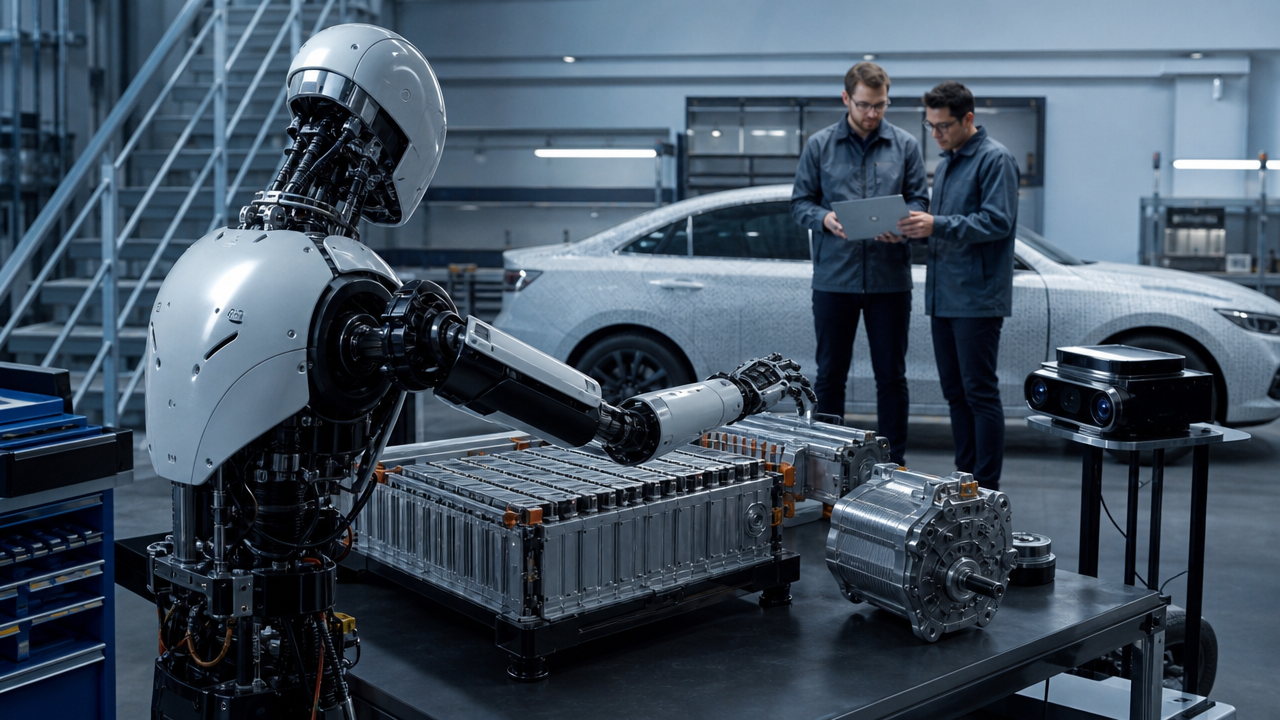
The field extends well beyond Xpeng. Chery's AiMOGA robotics unit was reportedly preparing for an initial public offering. BYD has shown a humanoid called Xiao Di, while Changan, GAC, Li Auto, SAIC and Seres are developing their own systems. The number of entrants creates useful competition around components and deployment, but it also raises the likelihood that demonstrations will outpace sustainable businesses. Shared suppliers can reduce cost even as companies struggle to identify work that pays for the robot.
The phrase embodied AI describes models that learn and act through a physical system rather than only producing text or images. In a factory, that means perception must stay connected to force, contact, joint limits and nearby workers. A model can choose the right abstract action and still fail because a gripper slips or an object is positioned differently from training data. Progress in vision-language-action models is important, but production engineering remains a chain in which the weakest mechanical or software component determines the result.
Commercial evaluation therefore needs operating measures that are less dramatic than launch videos. Task success must be measured across thousands of repetitions, not selected runs. Cycle time must be compared with a worker or a purpose-built machine. Recovery matters when a task fails, as does the time required for a technician to return the robot to service. Maintenance intervals, spare parts, energy use and supervision determine total cost. A robot that needs constant expert attention has moved the labor rather than removed it.
The Factory Is Becoming the Test Site
Global automakers are converging on the same experiment. Hyundai plans to bring Boston Dynamics' Atlas humanoid into its Georgia factory and ultimately use the machines for work such as parts sequencing. Atlas provides a reference point for sophisticated whole-body control, but Hyundai's advantage is the ability to place robots inside a real production system and observe what fails. Factory access produces data that is difficult for a standalone lab to reproduce because the edge cases come from everyday variation.
Hyundai is also working with Google DeepMind to accelerate development. That partnership illustrates another division of labor: automakers contribute hardware, sites and manufacturing knowledge, while AI labs contribute large models and training methods. Chinese companies may create their own versions of that stack internally or through domestic partners. The durable advantage will belong to the organization that closes the loop between fleet data, model updates, safety validation and service support without turning every software change into a new production risk.
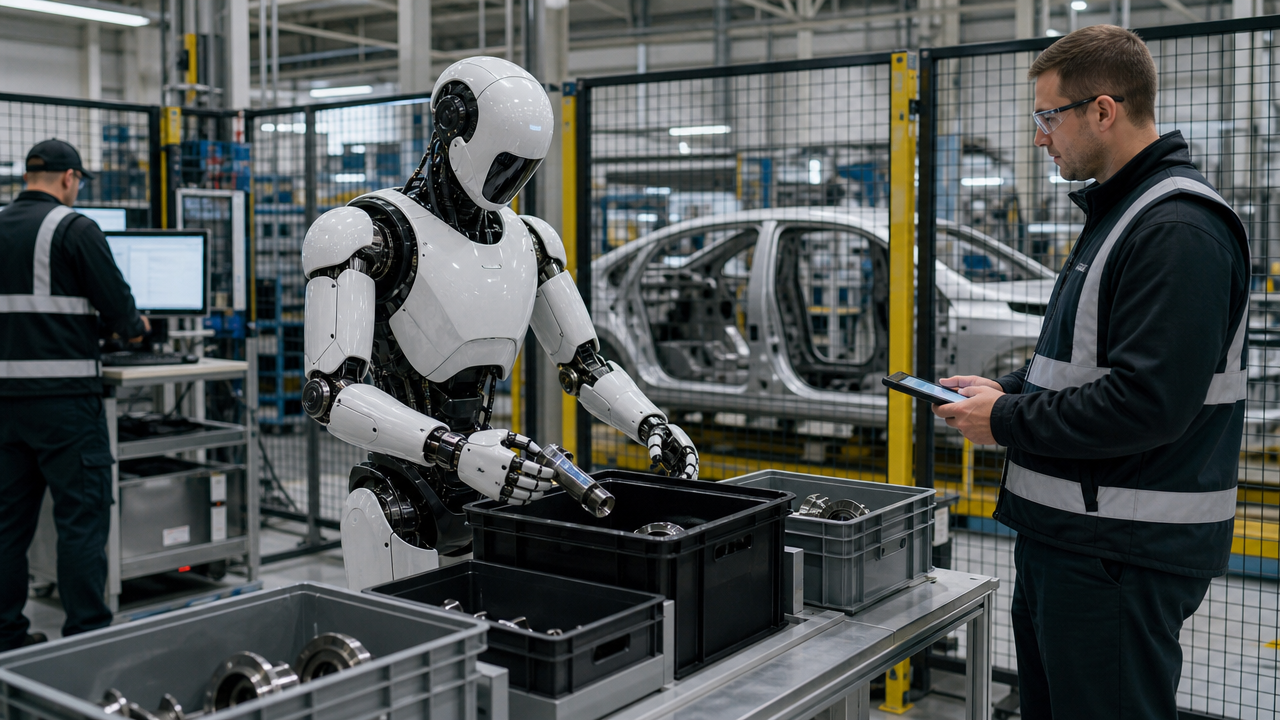
Independent robot developers remain part of the competitive picture. Apptronik, Agility Robotics and Figure are pursuing commercial deployments without the same vehicle businesses behind them. Their narrower focus can support faster technical iteration and clearer customer relationships. Automakers counter with purchasing power and manufacturing depth. Neither structure guarantees success. A startup can run out of capital before reaching reliability, while a large industrial group can sustain a program that never finds product-market fit.
China's automotive price war gives the diversification strategy urgency. When vehicle margins are thin, management teams naturally look for a second market where existing investment can produce higher returns. Humanoids offer a compelling narrative because they combine AI, advanced manufacturing and a potentially enormous labor market. That narrative can attract capital before recurring robot revenue exists. The more disciplined companies will treat internal factories as customers and require deployments to meet the same return thresholds as any other piece of equipment.
Manufacturing Scale Comes After Reliability
The ability to produce thousands of robots will matter only after each machine performs useful work. Scaling too early can lock in mechanisms that are difficult to maintain or sensors that do not survive industrial conditions. It can also multiply a safety defect across a fleet. Automotive quality systems are well suited to controlling those risks, but humanoids will require new test standards for balance, contact, tool use and behavior around people. The first deployments should be read as extended engineering programs, not proof that a general labor market has arrived.
Hands are likely to remain one of the hardest subsystems. Factory work often requires reliable grasping across objects with different weight, friction and deformability. A hand that looks human can contain many small actuators and sensors that increase cost and maintenance. Some deployments may succeed by replacing a dexterous hand with a task-specific tool. That compromise reduces generality but can improve cycle time and reliability, which is often the correct trade in a production cell.
Safety validation must account for learned behavior that does not follow a fixed program. Traditional industrial robots operate inside guarded areas or use certified limits when sharing space with people. A model-driven humanoid may encounter objects and instructions that were not present during validation. Manufacturers will need layered controls that constrain speed, force and workspace even when the high-level policy is uncertain. A language-level refusal is not a substitute for a physical safety controller.
Data ownership will shape partnerships between automakers, customers and model providers. A factory generates valuable examples of failures, recovery and edge cases, but customers may not want production footage or process details used to improve a shared model. Contracts will need to define what telemetry leaves the site, how workers are recorded and whether improvements trained on one customer can be sold to another. Those terms can become as commercially important as the robot's purchase price.
Labor effects will also arrive unevenly. Early systems are more likely to take repetitive or hazardous portions of a job than replace an entire occupation. Workers may become supervisors, maintenance technicians or process trainers, but those transitions require deliberate training and job design. If companies use a robot pilot only as a staffing announcement, they risk losing the people whose practical knowledge is needed to make the deployment function.
Leasing may emerge as the preferred commercial model because customers will hesitate to own an immature machine whose capabilities improve through software. A service contract can bundle maintenance and upgrades while giving the manufacturer fleet data. It also keeps capital and residual-value risk with the robot company. Automakers understand leasing, but humanoid utilization is less predictable than vehicle mileage, so pricing will require real deployment history.
Component standardization could lower costs across the sector if companies converge on batteries, joints or safety interfaces. Differentiation would then move toward models, hands and service. The opposite outcome, many proprietary platforms with small fleets, would slow learning and create expensive spare-parts inventories. China's manufacturing ecosystem can support rapid variety, but commercial maturity may eventually require fewer architectures and clearer interoperability.
The decisive evidence will come from quiet factory records: completed tasks per shift, intervention rates, injuries avoided, downtime and the cost of keeping each unit productive. Xpeng and other Chinese automakers possess many of the ingredients needed to improve those numbers. They still have to show that a human-shaped machine is the best solution for enough work to support the valuations now attached to their robot divisions. Until then, the move into humanoids is a credible industrial option wrapped in a financial search for margins.
Topics: China, humanoid robots, Xpeng, automakers, embodied AI