Research
KVBoost Proposes Flexible Cache Reuse in LLM Inference Without Position Constraints
Researchers introduce dual-hash keying to enable key-value cache chunks to be reused anywhere in a prompt, addressing a core inefficiency in large language model inference. The approach couples cache repositioning with deviation-guided recomputation to handle attention boundary mismatches, though independent performance validation remains outstanding.
By Michael G ·
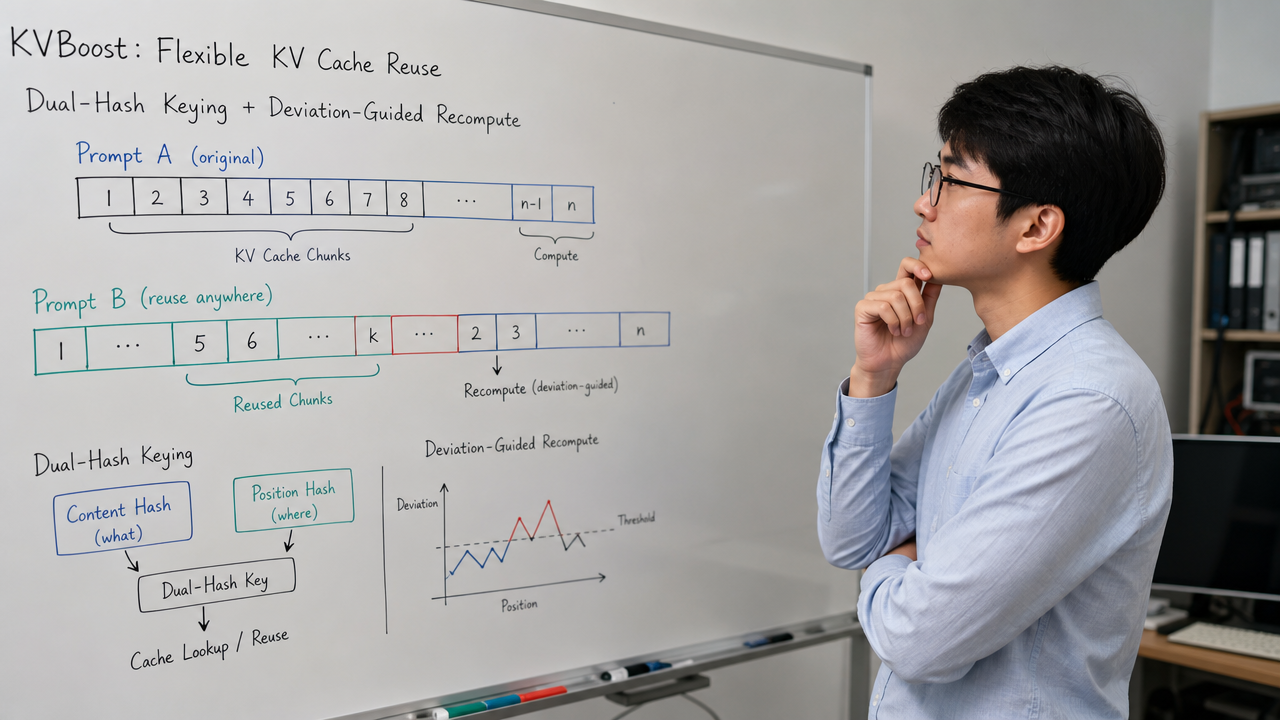
A new research proposal targets a structural limitation in how large language models reuse cached computation during inference. Current prefix caching methods lock key-value cache chunks to fixed positions within a prompt, meaning a reusable segment from one conversation cannot be deployed earlier or later in another without recomputation. The KVBoost paper introduces dual-hash keying that decouples cache chunks from their original prompt positions, enabling the same cached data to serve multiple inference paths regardless of where it appears.
The core technical contribution addresses what happens when cache chunks move. Because transformer attention operates over sequences, shifting a cached segment to a new position in the prompt changes the relative distances and dependencies that the attention mechanism must compute. KVBoost proposes deviation-guided recomputation to selectively recalculate attention values at boundaries where the cached chunk interfaces with new context, rather than recomputing the entire sequence. This hybrid approach aims to recover correctness without discarding the efficiency gains from cache reuse. KVBoost paper documents the reporting behind this account.
The research describes the mechanics as managing prefill latency and memory overhead. During the prefill phase, when an LM processes the entire input prompt before generating output, the model builds the KV cache. If segments of that cache can be repositioned and reused across different prompts, the prefill computation shrinks. The tradeoff involves memory footprint for storing dual-hash indices and the cost of selective recomputation at chunk boundaries. Workloads with repeated non-contiguous content, such as documents with boilerplate sections interspersed with unique material, theoretically benefit most from position-flexible cache reuse.
Validation and Performance Scope
The researchers present KVBoost as a demonstration within a controlled experimental framework. Like other preprint research hosted on arXiv, the proposal reflects the authors' implementation and testing methodology. Translating these results into production systems requires independent reproduction across different hardware configurations, model architectures, and inference patterns. The published benchmarks should be treated as research outcomes that depend on specific experimental conditions rather than as general performance guarantees. The operational tradeoff is also reflected in attention mechanism.

The practical question for inference systems is whether the overhead of maintaining dual hash tables and computing boundary corrections stays small enough to justify the benefit. Hardware constraints matter here. GPUs and TPUs have fixed memory bandwidth and cache hierarchies. Moving cache chunks around changes memory access patterns, and the performance impact depends on whether those patterns align with the accelerator's strengths. A configuration that shows latency wins one device might see diminishing returns on another if the recomputation logic falls out of cache or creates memory contention. This variability underscores why machine learning deployments require careful benchmarking against specific target hardware rather than relying on generic performance claims. For broader context, arXiv outlines the relevant standard or institution.
Applications and Limits
Cache reuse strategies generally apply well to scenarios where prompts share substantial overlapping content. Chatbot systems where users refine queries incrementally, or retrieval-augmented generation pipelines where multiple queries draw from the same document corpus, could theoretically benefit. Conversely, inference workloads with highly varied one-off prompts offer little opportunity for cache reuse regardless of flexibility. The proposal does not eliminate the fundamental constraint that cache chunks must correspond to valid semantic boundaries in the prompt, nor does it address the fact that different models may require different cache structures. machine learning helps place the issue within its wider policy and engineering context.

The research contribution sits within a larger engineering effort to reduce the inference cost of large language models. Prefix caching, speculative decoding, and quantization are complementary techniques that address different bottlenecks. KVBoost focuses specifically on cache positioning flexibility, not on model compression or generation speed. Whether practitioners adopt the approach depends on whether the measured latency and memory tradeoffs match real deployment constraints and whether the implementation proves stable across model variants. Reproducible research standards require that claims about performance improvements be accompanied by detailed methodology, published code, and sufficient documentation for independent teams to replicate results. The current status of KVBoost as a preprint indicates that the work is public but has not undergone peer review at a major venue. Anyone considering integration should plan for validation work with their specific hardware, model, and workload rather than assuming the published results generalize directly.
Topics: LLM inference, KV cache optimization, machine learning systems, research