Research
Researchers publish roadmap for task-agnostic exoskeleton control
Nature Machine Intelligence has published a framework for exoskeleton controllers that adapt across different users and activities without requiring separately tuned policies for each task. The roadmap addresses sensing, intent inference, personalization, and practical constraints that have limited real-world deployment.
By Michael G ·
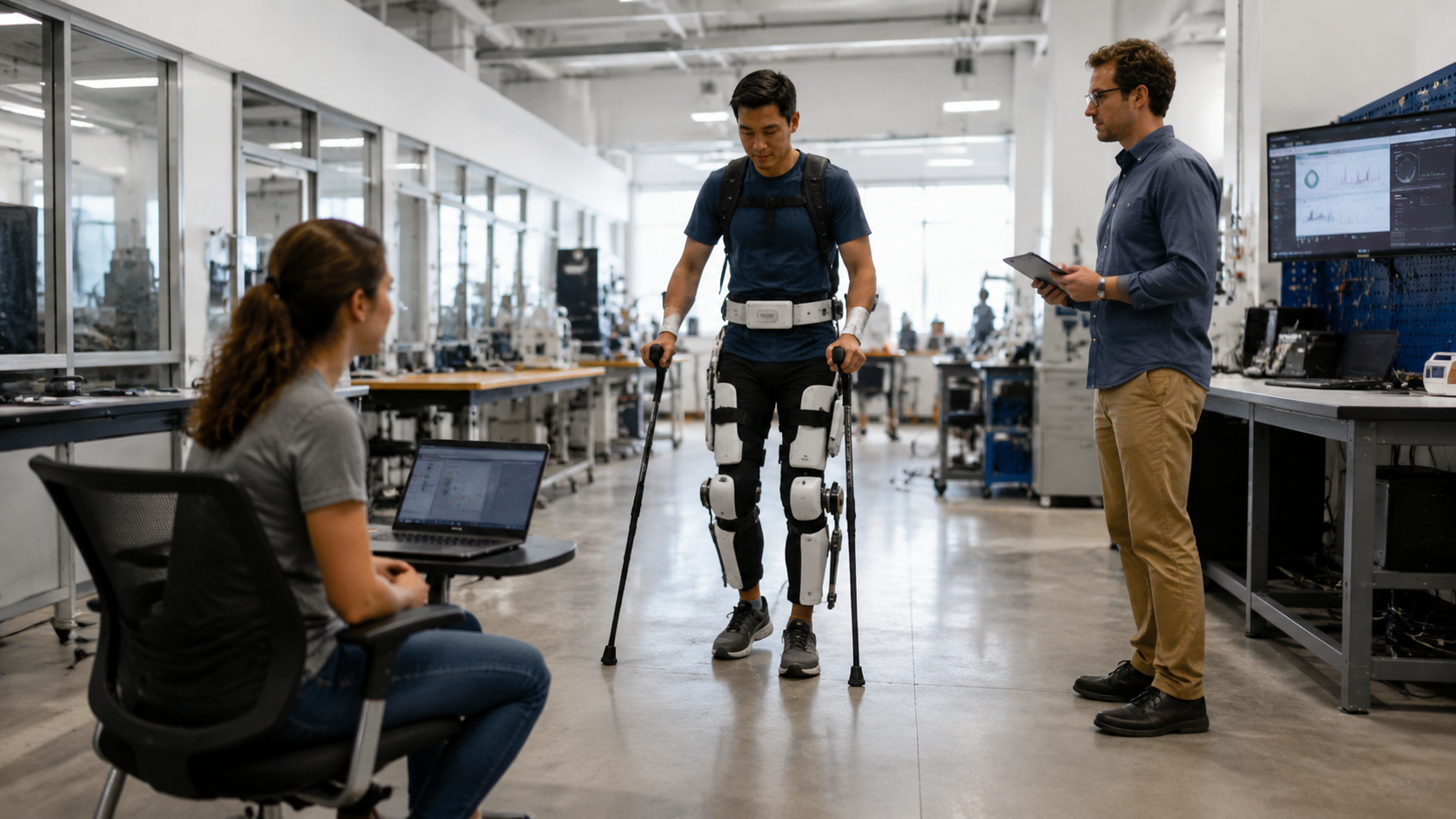
Researchers have outlined a comprehensive roadmap for developing exoskeleton controllers that work across different people and activities without requiring custom tuning for every task. Published in the Nature Machine Intelligence paper, the framework addresses a fundamental challenge in wearable robotics: most current systems require extensive calibration and separate control policies for each user and each distinct activity they perform. The roadmap identifies critical gaps in sensing, intent inference, personalization algorithms, safety validation, and the hardware constraints of batteries and actuators that must be resolved for task-agnostic control to move from laboratory demonstrations to clinical and real-world deployment.
The core problem is straightforward but difficult to solve. When a user walks at different speeds, navigates stairs, or switches to standing or sitting, the biomechanics change substantially. Current exoskeletons typically require engineers to manually adjust controller parameters for each scenario. This tuning burden scales with the number of users and activities, making real-world systems impractical for clinical settings or home use where diverse movement patterns occur throughout the day. A task-agnostic controller would instead learn or adapt to these variations automatically, applying a single unified policy across contexts. This capability is essential for assistive devices serving stroke survivors, spinal cord injury patients, or elderly adults who need consistent support across unpredictable daily activities. Nature Machine Intelligence paper documents the reporting behind this account.
The roadmap identifies sensing as a foundational layer. Current exoskeletons rely on combinations of joint encoders, accelerometers, and force sensors to measure body state and interaction forces. The framework notes that richer sensing modalities, particularly electromyography (EMG) from residual muscle activity, offer potential windows into user intent but present their own challenges: EMG signals are noisy, subject-specific, and degrade over time as electrode contact changes. The research highlights that sensor fusion strategies and noise-robust inference are prerequisites for intent detection. Without reliable sensing of what the user is attempting to do, the controller cannot adapt appropriately.
Intent inference and personalization
Intent inference stands at the center of task-agnostic control. The controller must recognize whether the user is beginning to walk, climb, stand, sit, or perform some other activity from partial, noisy sensor data. The roadmap discusses machine learning approaches including hidden Markov models and recurrent neural networks, but emphasizes that these methods require training data and validation across diverse populations. A critical distinction the framework preserves is between laboratory demonstrations and validated performance: experimental systems have shown activity recognition accuracies exceeding 95 percent in controlled settings, but deployment accuracy in uncontrolled home environments remains largely unquantified. The researchers stress that validation must occur across age groups, mobility levels, and pathologies, not just in young healthy subjects. Nature Machine Intelligence offers useful technical background for evaluating the claim.
Personalization layers on top of intent inference. Even if the controller correctly identifies that a user is walking, the appropriate motor support depends on that individual's strength, fatigue level, and preferred movement patterns. The roadmap proposes adaptive algorithms that adjust assistance in real time based on performance metrics like gait symmetry or stability margins. Some commercial systems already implement basic personalization, such as allowing users to select preset assistance levels. The research framework distinguishes this from closed-loop personalization, where the exoskeleton continuously estimates user-specific parameters and refines its control policy. Achieving robust personalization requires handling the diversity of human morphology, strength, and neuromuscular function, which varies significantly even within diagnostic categories.
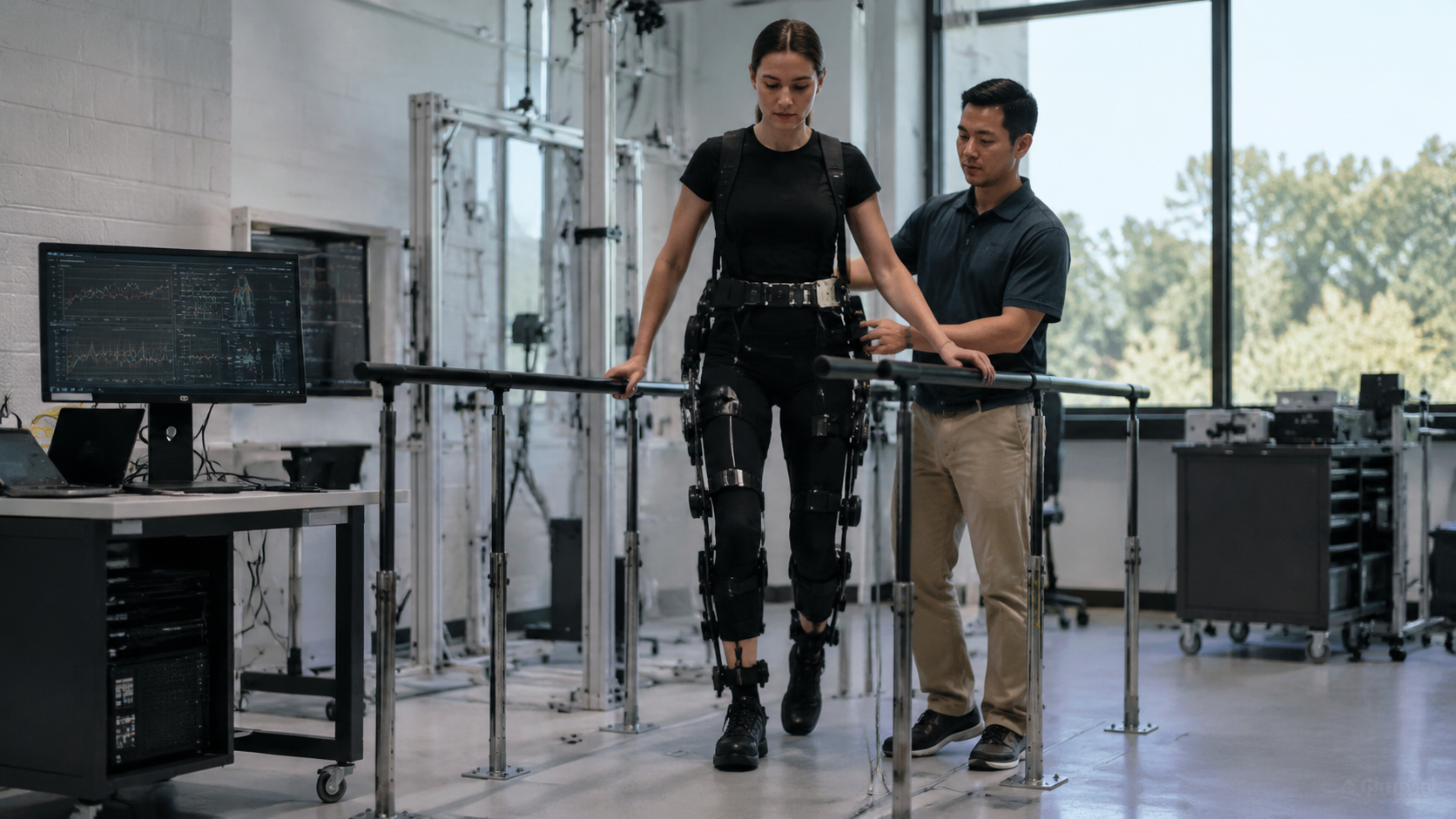
Safety validation emerges as perhaps the most critical unresolved challenge. When an exoskeleton malfunctions or misinterprets user intent, it can cause falls or injuries. The roadmap emphasizes that safety cannot be demonstrated through brief laboratory sessions. Clinical evidence must accumulate over extended use, across populations with varied mobility limitations, documenting both adverse events and near-misses. The framework notes that current regulatory pathways, primarily FDA clearances for specific indications and user populations, do not yet accommodate task-agnostic systems that nominally work across many activities. How regulators will evaluate safety for a device claiming broad functionality remains an open question. The research community has not yet established standardized testing protocols for validating safety across the diversity of tasks and users that task-agnostic systems claim to support. For broader context, robotics outlines the relevant standard or institution.
Hardware constraints and clinical translation
The roadmap also addresses physical constraints that no control algorithm can overcome. Batteries with current energy density limit exoskeleton operating time to roughly four to eight hours of continuous use, depending on the task and user weight. Actuators have maximum torque and speed ratings that determine the forces the exoskeleton can apply. An older adult weighing 100 kilograms ascending stairs requires more power than a lighter user ascending at the same rate. As users move between activities throughout the day, energy consumption varies, and the exoskeleton must either carry heavier batteries or operate at reduced assistance levels in the afternoon. The framework treats these as engineering tradeoffs rather than problems to be solved by better control theory. Understanding these constraints and communicating them clearly to users is essential before task-agnostic systems reach clinical settings.
Clinical translation requires gathering evidence that task-agnostic exoskeletons improve outcomes that matter to patients: independent mobility, reduced fall risk, faster gait speed, or reduced caregiver burden. Most published studies of assistive exoskeletons involve small sample sizes and relatively short follow-up periods, typically weeks to a few months. The roadmap calls for longer-term, larger-scale studies that track use patterns, adverse events, and functional outcomes in real-world settings. It also emphasizes the need for studies comparing task-agnostic systems directly to conventional assistive devices like walkers or canes, establishing whether the added complexity and cost deliver measurable benefits. autonomous systems helps place the issue within its wider policy and engineering context.
The research community has made progress on individual components of task-agnostic control. Neural interface systems can decode intended movements from brain signals in some contexts. Machine learning algorithms can classify user activities from sensor data with reasonable accuracy in test scenarios. Adaptive control methods can adjust assistance parameters based on real-time feedback. Yet integrating these components into a unified system that works reliably across diverse users and activities remains a research challenge. The roadmap does not claim that task-agnostic control is imminent, but rather maps the technical, regulatory, and clinical work required to make it practical. For users of assistive exoskeletons, that distinction matters: research progress should not be confused with deployment readiness. Until clinical evidence accumulates and regulatory frameworks adapt, task-agnostic systems will likely remain in the research and early-commercialization phase. The final point can be checked against IEEE Robotics and Automation Society.
Topics: exoskeletons, robotics, control systems, research, assistive technology