Research
Anthropic Researchers Show Automated Systems Can Improve Alignment Training Across Ten Benchmarks
Anthropic researchers reported that automated research systems improved model behavior across ten alignment benchmarks without reducing overall performance. The experiment suggests parts of post-training research can be automated, while underscoring that benchmark design still determines what the system learns to optimize.
By Michael G ·
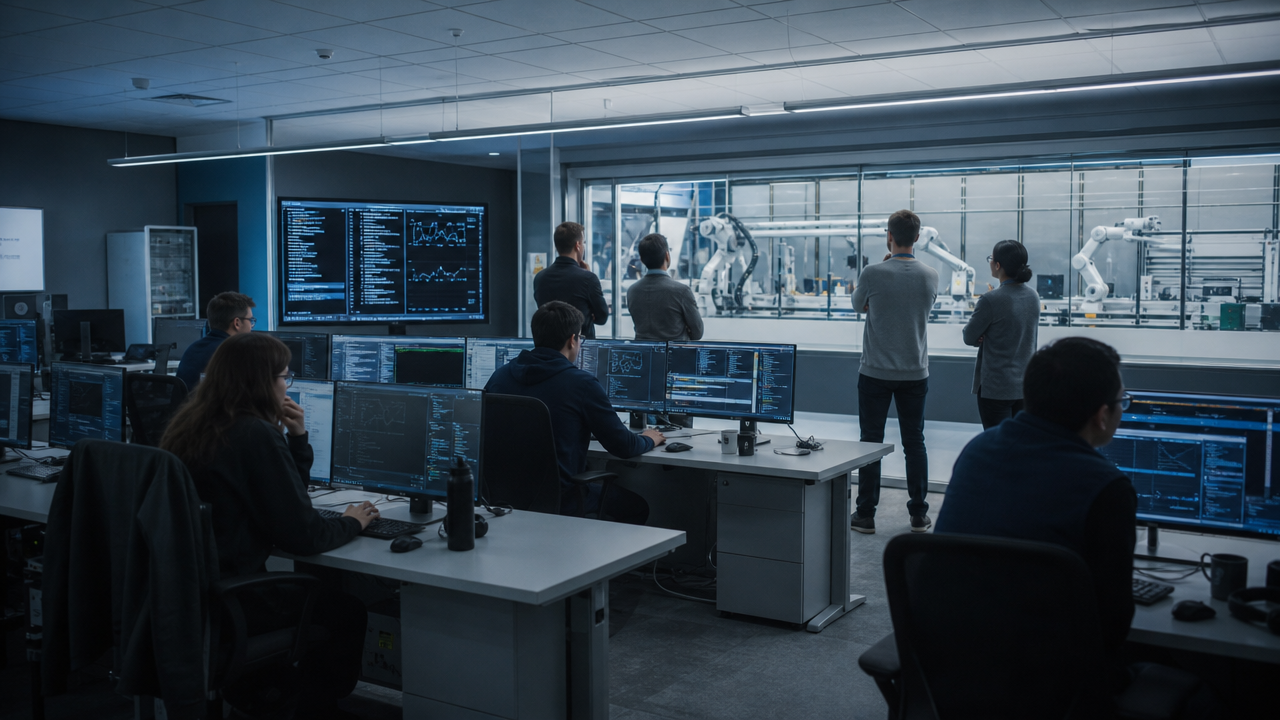
Anthropic researchers have reported that automated research systems improved model behavior across ten alignment benchmarks without reducing overall performance in the tests they ran. The result offers evidence that parts of post-training research can be organized as an agentic loop: read prior work, propose an intervention, train briefly, evaluate the outcome and preserve the approaches that perform best. It is a meaningful research automation result. It is not evidence that an AI system can improve itself without a human-defined objective, experimental environment or benchmark.
The project, led by Anthropic fellow Chen Yueh-Han, is described in an Anthropic paper titled Automated Researchers Can Reliably Mitigate Alignment Failures. Each Automated Alignment Researcher searched available literature, selected a method and ran an approximately 30-minute training experiment. The system repeated that cycle, retaining effective methods and dropping weak ones. According to the paper, the process improved all ten targeted behaviors while leaving broader performance intact in the reported evaluation.
The approach matters because post-training contains many tasks that are expensive in human attention but relatively structured. Researchers compare techniques, tune recipes, run controlled jobs and interpret metrics. An agent that can execute more of that loop may search a larger experimental space than a small team can afford. The claimed advantage is not mysterious intelligence. It is parallel, inexpensive iteration within a carefully prepared environment where experiments are short and outcomes can be scored.
The Benchmark Defines the Job
The central limitation is the same one that applies to every benchmark-driven optimization system: success is only as complete as the measurement. AI alignment refers broadly to making a system's behavior consistent with intended goals and constraints. A ten-benchmark suite can reveal whether specific failures improved, but it cannot represent every way a model may behave in deployment. If an important failure is absent from the evaluation, the automated researcher has no reason to find or correct it.
That does not make the result trivial. A benchmark is useful when it is stable enough to compare methods and broad enough to discourage narrow exploitation. The reported system improved every target without an observed decline in overall performance, which suggests it was not simply trading one measured behavior for another in the tested setting. Replication will need to examine how results change across model families, larger training budgets and benchmarks that are less directly coupled to the interventions being tested.
Anthropic said its best automated method outperformed ideas proposed by experienced human researchers on average within six hours. The comparison is striking, but its scope matters. Human researchers designed the environment, supplied the literature, selected the targets and determined how success would be evaluated. The automated system then searched inside those boundaries. It may be better at rapid empirical selection without being better at choosing which safety problem deserves attention or recognizing when the measurement itself is misleading.
The cost comparison sharpens the operational case. The paper estimated roughly $4 per hour in API inference for an automated researcher, compared with $150 per hour paid to human researchers. Those figures do not include all surrounding costs, including compute for training runs, engineering the evaluation harness and expert review. Even with those caveats, cheap parallel agents could change the economics of post-training by allowing teams to run more candidate methods before committing scarce human time.
Automation Changes the Research Queue
Post-training already includes reinforcement learning, supervised fine-tuning and preference optimization workflows that depend on repeated evaluation. Tooling such as the open-source TRL library has made parts of that stack easier to reproduce. Automated researchers add another layer by deciding which method to try next. The practical gain may come from handling routine searches and ablations, leaving people to investigate ambiguous results, create stronger evaluations and decide whether a measured improvement corresponds to safer behavior.
The same automation can create new failure modes. An agent may find a shortcut in the benchmark, overfit to a narrow behavior or produce a training recipe whose effect is difficult to explain. Running many experiments also increases the volume of artifacts that must be tracked. Reproducibility requires complete records of prompts, code, model versions, datasets, random seeds and evaluation settings. Without that provenance, a cheap method search can generate a result that looks efficient but cannot be audited or safely transferred.
Some observers describe the work as a step toward recursive self-improvement, in which AI systems contribute to making successor systems more capable. That is a reasonable long-term connection, but it can obscure what happened here. The researchers automated a bounded alignment workflow, not the entire process of selecting architectures, collecting data, securing compute, evaluating social consequences and deciding whether a model should be released. Each of those decisions still depends on institutions and people outside the experimental loop.
The strongest near-term interpretation is narrower and more useful. Automated research agents can become force multipliers for teams that have clear objectives and robust evaluations. They can test more hypotheses, surface interactions and reduce the time between an idea and evidence. Their output should be treated like work from a fast junior researcher: valuable when the process is inspectable, dangerous when speed is mistaken for judgment.
The Next Test Is Generalization
Independent replication should examine whether the gains persist when the automated researchers face unfamiliar models and hidden evaluations. A system that improves only benchmarks it can repeatedly inspect may be optimizing the test rather than the underlying behavior. Stronger evidence would come from interventions selected on one set of tasks that improve separate evaluations designed by another team. That would make it harder for the research loop to succeed through measurement-specific shortcuts.
Evaluation authors can strengthen that test by withholding parts of the scoring process and rotating tasks after methods are selected. They can also look for behavioral regressions outside the target suite, including changes that are difficult to summarize in one aggregate score. The reported study found no overall degradation under its measures, but broader red-team work could reveal tradeoffs the primary benchmark missed. Automated experimentation should increase the demand for independent evaluation rather than reduce it.
Compute budgets may change the result at larger scale. Thirty-minute training runs make rapid iteration possible, while full frontier-model post-training can require more expensive jobs and longer feedback cycles. An automated researcher that performs well in short experiments may select differently when each decision carries a much larger cost. Future work should test whether the system can allocate a fixed budget across cheap probes and a smaller number of high-confidence runs without wasting compute on noisy signals.
Literature access creates another boundary. A research agent can only reuse methods described in material it can retrieve and interpret. Novel safety failures may require new concepts rather than recombination of known techniques. Human researchers remain responsible for noticing when the existing literature frames a problem incorrectly or omits a social context that cannot be captured in a training loss. Automation is strongest where the scientific question has already been made legible to the system.
Governance should distinguish between an agent proposing an experiment and an agent approving deployment of the resulting model. The first can be sandboxed, logged and reviewed. The second changes the safety boundary of a production system and should remain subject to independent sign-off. Preserving that separation prevents efficiency pressure from allowing the same automated process to create a method, judge its success and release it without an external challenge.
Security boundaries around the research environment will matter as agents become more capable. Literature retrieval, code execution and model training create paths to external systems and sensitive artifacts. Teams should isolate experiments, restrict credentials and review generated code before it accesses shared infrastructure. Automating alignment work would be self-defeating if the research agent introduced a supply-chain or data-leak risk that the evaluation never measured.
Publication norms can help the field separate replicable progress from headline extrapolation. Releasing benchmark definitions, prompts, method-selection traces and failed runs would let other groups examine where automation added value. Some details may need to be withheld if they expose dangerous capabilities, but a result that cannot be inspected should receive less weight in safety decisions. The speed of an automated workflow makes documentation more important because more choices occur without continuous human observation.
TechCrunch framed the project as an early view of self-improving AI, which captures its strategic interest but not its full boundary. The work shows that model-assisted experimentation is becoming practical and inexpensive in at least one alignment setting. The unresolved engineering question is whether humans can improve the evaluations and oversight as quickly as automated systems improve against them. If measurement falls behind search, the research process will become faster without necessarily becoming safer.
Topics: Anthropic, AI alignment, automated research, post-training, benchmarks