Technology
Toyota North America deploys 50 production agents, cuts some delivery timelines to four days
Toyota North America has deployed 50 production agents using LangChain's Deep Agents and LangSmith, according to a customer case study, reducing certain deployment timelines from six months to four days. The deployment highlights how structured AI workflows, observability tools and approval systems are reshaping enterprise software delivery.
By Patrick T ·
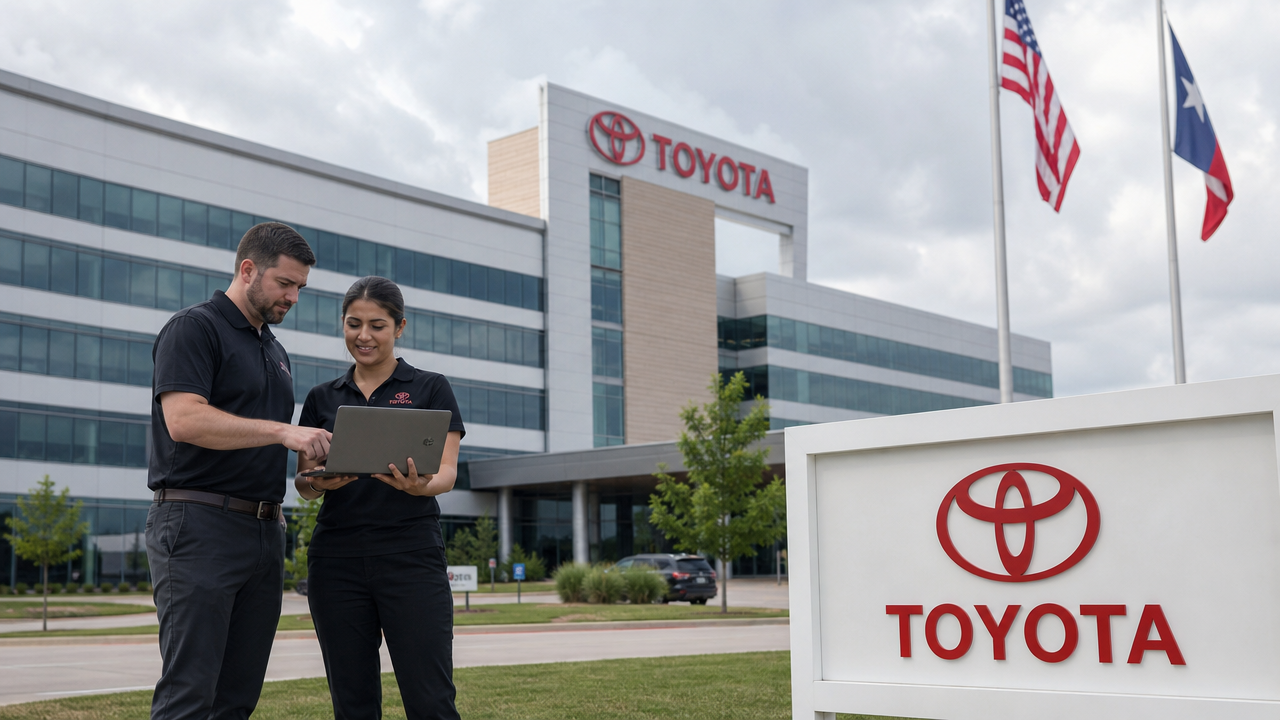
Toyota North America has put 50 production agents into operation using LangChain's Deep Agents framework and LangSmith observability platform, according to a LangChain customer story published this month. The automaker says the deployment reduced deployment timelines for certain processes from six months to four days, a compression that reflects both the speed of agent-based automation and the operational rigor required to run such systems at scale in a manufacturing and logistics environment.
The deployment demonstrates how Toyota operationalized agents within constraints that matter to large manufacturers: narrowly scoped workflows, approval gates, observability that tracks agent decisions, failure recovery mechanisms, and ROI measurement that ties automation to measurable cost reduction. A vendor case study is not independent proof of performance or generalizability, but it does provide a concrete example of how one large organization has integrated agent-based systems into production environments. The structure of agent-based work differs fundamentally from traditional software deployment. Rather than building a monolithic application and shipping it once, agents operate within defined boundaries and make decisions across iterations. LangChain customer story documents the reporting behind this account.
Toyota's use of LangSmith, LangChain's observability tool, suggests the company is treating visibility into agent behavior as a core operational requirement. Observability in this context means logging what agents observe, what decisions they make, and whether those decisions align with expected outcomes. Without it, a fleet of 50 agents becomes difficult to debug, audit or improve. For Toyota North America, the speed gain from four-day deployments is only useful if the agents make reliable decisions within acceptable risk bounds. Manufacturing and logistics are low-margin, high-volume operations where a single agent error can cascade across supply chains. The case study indicates that Toyota's deployment includes approval workflows, meaning certain agent decisions require human review before execution. This introduces a human-in-the-loop pattern that slows individual decisions but increases confidence in the overall system.
Infrastructure and deployment velocity
Failure recovery, the ability for agents to recognize mistakes and either correct them or escalate them, is another operational requirement that the case study cites as part of the deployment. The four-day timeline that Toyota cites is not a measure of how fast agents make decisions, but how fast the company can move from identifying a need to putting an agent in production. Compressing that timeline from six months suggests the company has built infrastructure for rapid deployment: templates for agent definition, integration points with existing systems, compliance and security pre-clearance, and testing frameworks that can validate agent behavior in hours rather than weeks. This kind of infrastructure is expensive to build but yields compounding returns as more agents enter production. The operational tradeoff is also reflected in LangSmith.

Measurement and the limits of vendor claims
Toyota's deployment raises a question that most enterprise AI initiatives stumble on: how do you measure ROI for agents? LangChain, the vendor behind Deep Agents and LangSmith, has obvious incentive to highlight successful customer deployments. Toyota, as the customer, has incentive to demonstrate that its AI investment is working. Neither party has incentive to publish a case study showing that agents are underperforming or that the company is breaking even. A credible ROI claim would need to account for the cost of infrastructure, observability tools, human oversight, and the engineering time spent building and maintaining agent workflows. The case study attributes cost reduction to Toyota's deployment, but independent verification of those numbers is not available.

Toyota's investment in enterprise AI infrastructure reflects a broader shift across large organizations. Where cloud computing transformed capital expenditure into operational expense a decade ago, agent-based automation is beginning to reshape how companies think about labor and process design. The initial cost of building agent systems is high, but marginal deployment of new agents becomes cheaper once the platform exists. Toyota's claim that it can move from concept to production in four days suggests the company has crossed that inflection point. The deployment of 50 agents is neither trivial nor unprecedented at Toyota's scale, but the public disclosure of the timeline and the specific tooling used signals that the company views its AI infrastructure as strategic advantage, not experiment. Other manufacturers and logistics operators will likely follow similar paths, building observability and governance into agent systems from the start rather than retrofitting them. How quickly that pattern spreads, and whether the four-day timeline becomes a benchmark or remains specific to Toyota's internal processes, will depend on how well other organizations can replicate the infrastructure investments that make rapid deployment possible.
Topics: enterprise AI, automation, software delivery, LangChain, manufacturing