Policy
Policy roadmap targets AI safeguards against biological weapons development
A new policy framework calls for stronger controls on advanced AI models to reduce risks that they could assist in biological weapons development. The roadmap emphasizes evaluation methods, access controls, and coordination between government and technology companies.
By Michael C ·
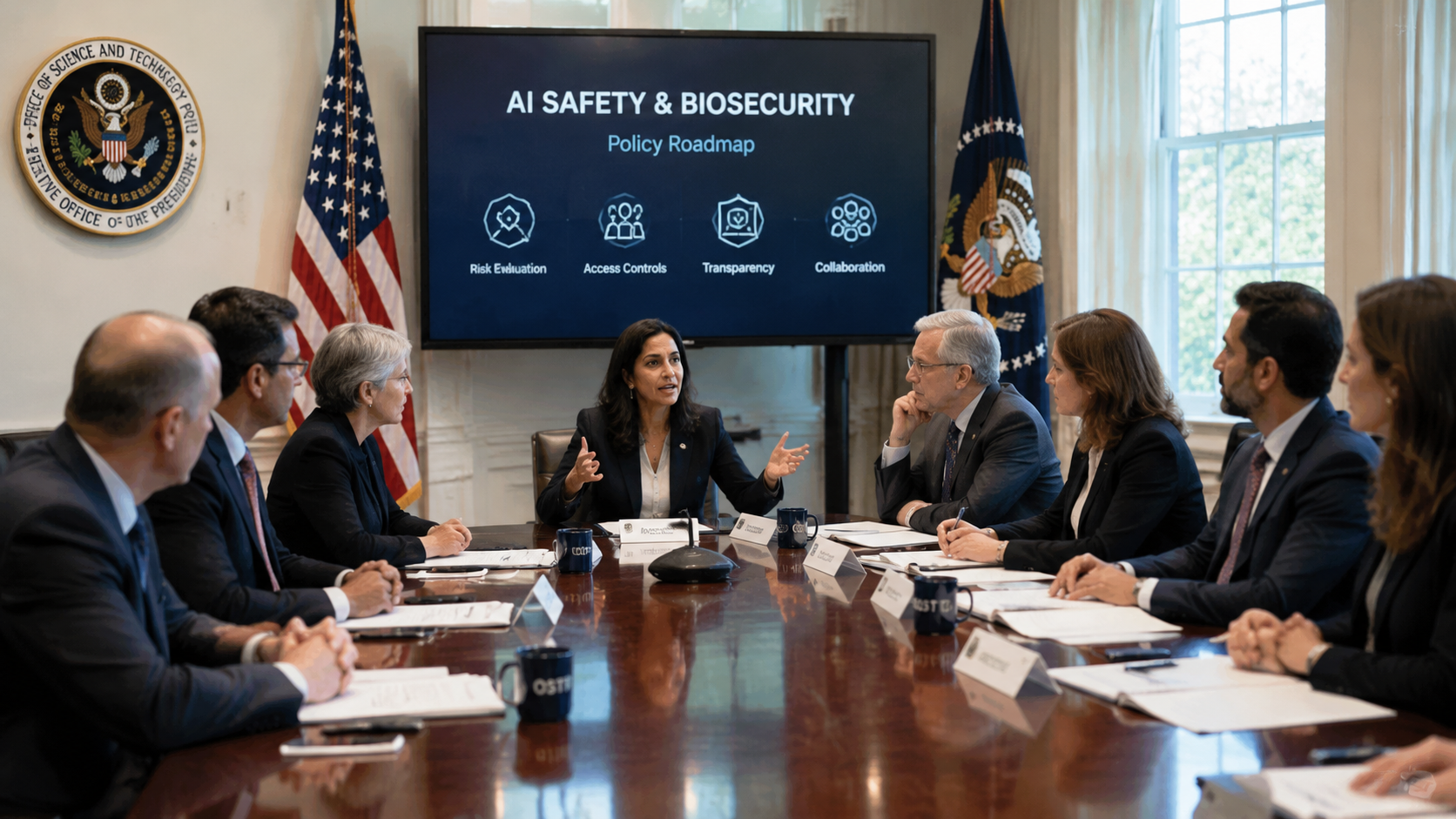
A comprehensive policy roadmap released this week proposes new safeguards designed to reduce the risk that advanced artificial intelligence models could assist in the development of biological weapons. According to an Axios report, the framework addresses a specific concern among security experts and policymakers: that large language models and similar systems, trained on vast troves of publicly available information, may lower some informational and planning barriers that historically protected sensitive biological knowledge. The roadmap does not suggest that AI alone creates biological threats, but rather identifies it as one factor among many that includes access to materials, specialized expertise, laboratory infrastructure and execution capability.
The policy framework focuses on four main operational areas. First, it calls for improved evaluation methods to identify when and how models might provide assistance with biological weapons development. Second, it proposes access controls that could limit or monitor how certain users interact with sensitive model capabilities. Third, it establishes protocols for incident reporting when concerning uses are identified. Fourth, it emphasizes coordination mechanisms between government agencies, technology companies and international partners to share threat information and best practices. Each area remains contested among experts because the operational boundaries are unclear: determining what constitutes concerning capability, which access restrictions are effective, and how to share sensitive information without compromising security or economic competitiveness. Axios report documents the reporting behind this account.
The initiative reflects growing recognition that biological security in an era of advanced AI requires institutional frameworks that did not exist when older biological security policies were established. The Biological Weapons Convention, first opened for signature in 1972 and now binding on over 180 states, prohibits development and stockpiling of biological and toxin weapons but was drafted before machine learning existed. The World Health Organization has issued biosafety and biosecurity guidance, but these frameworks similarly predate current AI capabilities. Policymakers now face the question of how to adapt international agreements and domestic regulations to address risks that span technology development, scientific research, public health and national security simultaneously.

Evaluation and Access
The roadmap's evaluation component draws on existing models from AI safety research, including the NIST AI Risk Management Framework, which provides methods for identifying and assessing risks in deployed AI systems. Evaluators would test whether models can be prompted to provide information on pathogen synthesis, cultivation techniques, weaponization methods or dispersal strategies. The challenge lies in distinguishing between dual-use information, which has legitimate scientific and public health applications, and information whose primary utility is weapons development. A microbiology researcher studying disease mechanisms might need access to similar information as someone designing a biological weapon. The policy framework does not resolve this distinction but acknowledges it as a central technical and ethical problem requiring ongoing collaboration between AI researchers, biologists and security experts.
Access control proposals vary in scope. Some suggest restricting model access by requiring identity verification and institutional affiliation for users asking sensitive questions. Others propose limiting what information models return when queried about biological weapons explicitly. Still others recommend monitoring for suspicious usage patterns without blocking access entirely. Each approach carries tradeoffs between security and openness. Restrictive access could slow legitimate scientific research or create barriers for researchers in countries with limited institutional resources. Permissive access preserves scientific openness but may provide assistance to actors with harmful intent. The roadmap emphasizes that access decisions should reflect both security assessment and broader policy goals including scientific progress and equitable access to technology. The operational tradeoff is also reflected in Biological Weapons Convention.
The OECD AI principles, adopted by member countries to guide responsible AI development, emphasize transparency and stakeholder engagement in AI governance. The roadmap aligns with this emphasis by proposing that access policies be developed through dialogue between technology companies, government agencies and the scientific community rather than through unilateral corporate or regulatory decisions. This coordination requirement reflects recognition that no single actor possesses complete information about risks or solutions. Companies understand their systems best but lack full visibility into security threats. Government agencies understand threat landscapes but may lack technical expertise in AI. The scientific community understands dual-use implications but operates independently from policy processes. Building institutional relationships across these groups remains incomplete and contested. For broader context, NIST AI Risk Management Framework outlines the relevant standard or institution.

International Coordination and Accountability
The roadmap's most ambitious component addresses international coordination. Biological security has long been understood as requiring global governance because pathogens do not respect borders and because dual-use research occurs across many countries. The framework proposes that countries establish channels for sharing information about concerning AI model capabilities without revealing either sensitive security details or proprietary AI system design. The mechanics of such information sharing remain largely theoretical. OECD AI principles helps place the issue within its wider policy and engineering context.
The UNESCO AI ethics recommendation, adopted by member states in 2021, calls for governance mechanisms that reflect values including human rights, environmental protection and social responsibility. The roadmap references these principles while acknowledging that implementing them in biological security contexts requires navigating tensions between competing values: security versus scientific openness, national interests versus international cooperation, and risk prevention versus precaution against overreach. The framework emphasizes that safeguards should be designed with transparency and public trust in mind, not as opaque security measures imposed without explanation or accountability.
Enforcement mechanisms remain underdeveloped in the roadmap. Who monitors compliance with access controls and incident reporting requirements? What penalties apply if companies fail to implement safeguards or conceal concerning uses? How are international disputes resolved when countries disagree about whether certain AI capabilities constitute biological weapons risks? The roadmap identifies these questions as requiring further work rather than providing definitive answers. This reflects the genuine uncertainty that exists: biological security governance structures designed for biological research and weapons inspections exist, but analogous structures for AI governance are nascent and contested.
The roadmap's fundamental premise remains measured and evidence-based: advanced AI models may reduce some barriers to biological weapons development, but actual biological harm depends on multiple factors beyond model capability. Access to pathogens, specialized laboratory equipment, training in microbiology and molecular biology, and sustained effort toward weaponization all remain prerequisites for biological weapons development. The risk is not that AI models create biological threats from nothing, but that they may lower the threshold for actors who already possess some combination of motivation, expertise and resources. The policy framework aims to raise that threshold back through safeguards that preserve beneficial AI applications while reducing specific risks to biosecurity. Whether such calibration is achievable remains an open question that experience will ultimately answer. The final point can be checked against UNESCO AI ethics recommendation.
Topics: artificial intelligence, biosecurity, policy, weapons, public health