Ethics
Pentagon Seeks $30 Million AI System for Remote Lie Detection
A proposed Polygraph+ program would apply machine learning and contactless sensing to credibility assessments, reviving scientific and civil-liberties questions around lie detection.
By Michael C ·

WASHINGTON. The Pentagon's Defense Counterintelligence and Security Agency is seeking roughly $30 million over five years for Polygraph+, a program intended to combine machine-learning scoring with contactless sensing. The proposal promises a more scalable credibility assessment, but it enters a field where accuracy claims have long exceeded scientific consensus.
Traditional polygraphs infer deception from physiological signals such as breathing, pulse and perspiration. Those signals can reflect stress, fear, disability, medication or the stakes of an interview rather than a lie.
What Changed
Adding AI does not solve the underlying measurement problem. A model can find subtle patterns in sensor data, but it still needs a valid label for deception and a representative population. If the labels come from contested polygraph outcomes, the system may reproduce uncertainty with greater numerical confidence.
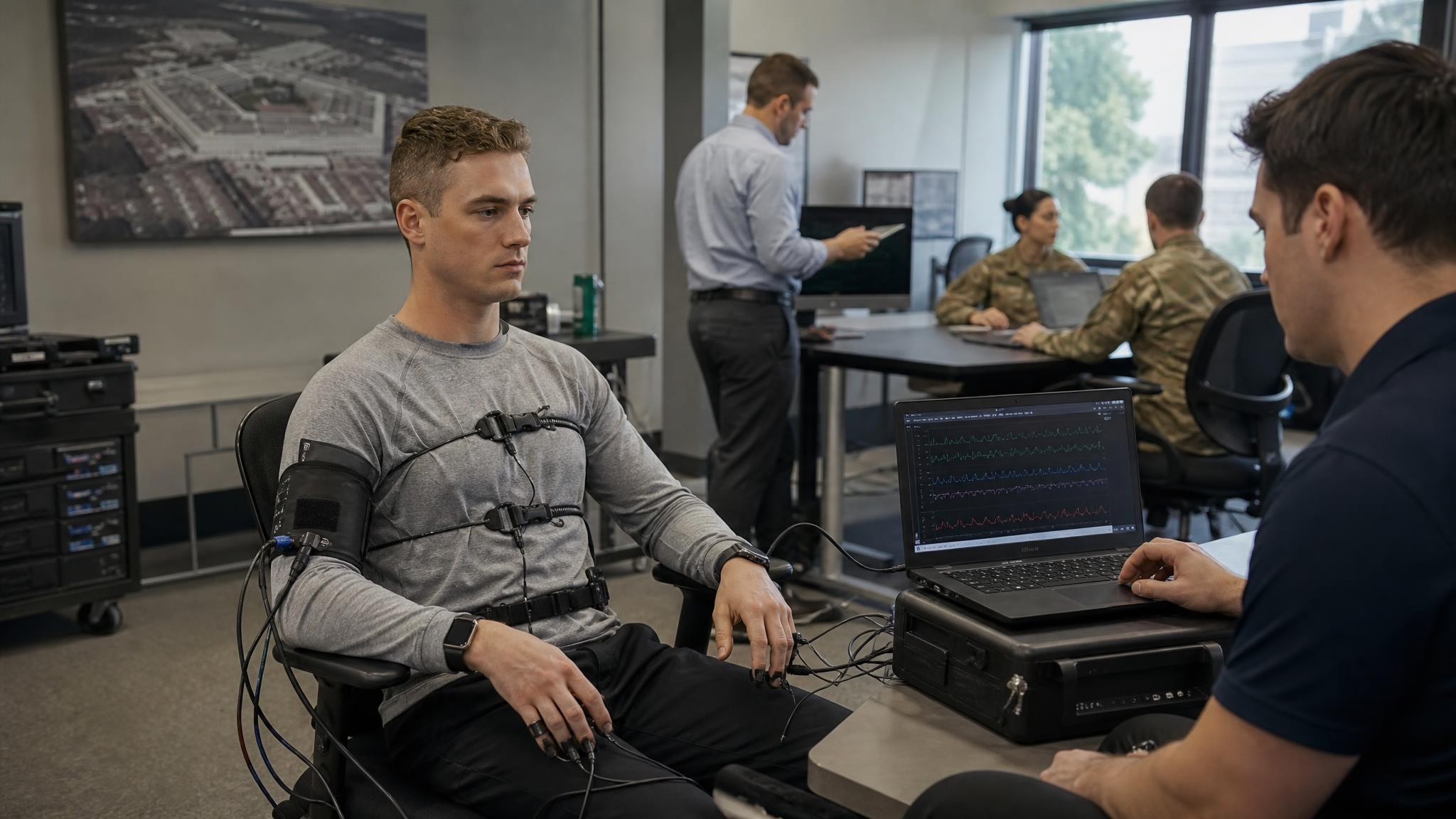
Remote sensing also changes the power relationship. A person may not know which signals are being collected or how an algorithm interpreted them. In security screening, an opaque score can influence employment and clearance decisions that are difficult to challenge.
An ethical review has to follow the people affected by a system, including those who never chose to use it. Consent, appeal, accessibility and the distribution of errors matter as much as average performance. A product can look accurate overall while imposing concentrated harm on a smaller group.
Institutional legitimacy depends on a visible chain of responsibility. A model can assist a decision, but an accountable organization still has to explain, defend and correct the outcome.
Transparency should be practical rather than ceremonial. Users need to know when AI shaped a decision, what information mattered and where they can challenge the result. A long policy page cannot substitute for an explanation delivered at the moment a consequential decision is made.
The Operational Test
Before deployment, the agency should publish validation methods, subgroup performance, appeal procedures and clear limits on use. Independent scientists need access to test whether results hold outside controlled settings and whether examiners over-trust the automated score.

The first discipline in evaluating this development is to separate the confirmed news from the expectations around it. A proposed Polygraph+ program would apply machine learning and contactless sensing to credibility assessments, reviving scientific and civil-liberties questions around lie detection. That is meaningful on its own, but it does not prove every commercial, scientific or political claim attached to the story. Readers should distinguish what was announced, what outsiders have observed, what remains an assertion and what would have to happen for the broader promise to become real.
Pentagon sits inside a wider network of suppliers, customers, regulators, researchers and people expected to use the technology. A change at one layer can move cost or risk into another rather than eliminate it. The practical analysis follows the whole chain, including who supplies infrastructure, who controls access, who reviews an output and who carries responsibility after a failure.
Incentives deserve close attention. Organizations connected to Polygraph+ may benefit from faster adoption, favorable rules, larger budgets or a stronger competitive position. That does not make their claims false, but it makes transparent methods and independent testing important. A useful disclosure explains the comparison, the conditions and the cases that did not work.
Accountability also has to remain attached to a person or institution. Automated systems can recommend, rank, summarize or act, but they cannot carry legal or moral responsibility in the way an organization can. Teams deploying technology connected to lie detection should name an owner for approval, monitoring and incident response, with authority to pause the system and require a design change.
The strongest implementation plans begin with a bounded use case and an explicit baseline. Teams should know how the work is performed today, how long it takes, what errors occur and which outcomes matter before introducing a new system. They can then compare accepted results, correction time, total cost and policy violations rather than celebrating raw activity.
Procurement should reflect the same discipline. Buyers need to ask where data is processed, how long it is retained, which subcontractors receive it, how model changes are communicated and whether records can be exported if the relationship ends. Demonstrations favor clean inputs and successful paths; production contains incomplete instructions, conflicting permissions and unusual edge cases.
People, Power And Trust
Workers and users determine whether the technology becomes dependable. Training cannot be limited to prompt tips. People need to understand when a system is likely to fail, how to verify an important result and where to report behavior that does not fit the expected pattern. They also need protection from incentives that reward speed while punishing caution.
Public trust depends on institutions communicating uncertainty honestly. Clear boundaries make a system easier to use responsibly. A provider should say which tasks were tested, which populations or environments remain underrepresented, what monitoring is in place and how users will learn about a serious incident.
The distribution of benefits matters as well. New capability can lower cost and extend access, yet it can concentrate control in organizations that own compute, data and customer relationships. Policymakers should ask whether smaller firms, public institutions and researchers can participate on reasonable terms. Companies should ask whether efficiency gains reach customers and workers.
Global differences complicate deployment. Privacy law, labor rules, infrastructure capacity and public tolerance vary by country and city. A system evaluated in one market may encounter different languages, workflows and expectations elsewhere. Localization requires local testing and a willingness to narrow a feature when the evidence does not support the same autonomy everywhere.
Implementation will also expose dependencies hidden by the announcement. Work connected to Pentagon may rely on a cloud region, identity provider, data license, hardware supplier or external API that the adopting organization does not control. A resilient design identifies those dependencies before launch, assigns an owner to each one and defines how the workflow degrades when a service is unavailable. Otherwise a narrow outage or policy change can become an organization-wide interruption.
Data quality deserves the same scrutiny. Systems associated with Polygraph+ can produce a polished result from incomplete, stale or incorrectly joined records. Confidence in the presentation can then exceed confidence in the source. Teams need lineage that shows where important facts came from, when they were updated and which transformations occurred before a model saw them. That record supports both correction and accountability.
Human review must be designed around the actual limits of attention. Asking a person to approve hundreds of routine outputs does not create meaningful oversight; it creates a predictable tendency to click through. Review should concentrate on uncertainty, unusual actions and cases with irreversible consequences. The interface should explain why a case was escalated and give the reviewer enough source material to make an independent judgment.
Smaller organizations face a different version of the problem. They may benefit most from capability connected to lie detection, yet they often lack procurement lawyers, security engineers and evaluation teams. Providers should offer usable defaults, clear contracts and logs that do not require a specialist platform to interpret. Regulators and industry groups can help by publishing test methods that a school, clinic or mid-sized company can apply without recreating a frontier laboratory.
The environmental cost should not disappear from the accounting. Training, inference, storage and networking consume energy and water through a supply chain that may cross several regions. Efficiency improvements can lower the footprint of one task while total demand rises faster. Companies should report resource use in a form customers and communities can compare, including the assumptions behind offsets and claims about renewable power.
Labor effects will arrive unevenly. Some workers will use the system to remove repetitive steps, while others may inherit more monitoring, faster quotas or responsibility for correcting automated work. Leaders should involve the people who understand the current process before deciding what to automate. Their knowledge often reveals exceptions and informal safeguards that are absent from an official workflow diagram but essential to quality.
A mature deployment also needs an exit plan. Models are retired, vendors change terms and organizations discover that an early architecture no longer fits. Records should remain portable, automated decisions should be reproducible and critical workflows should not depend on one undocumented prompt. The ability to leave a provider is both commercial leverage and a safety control because it keeps a disappointing experiment from becoming permanent infrastructure.
Scenario testing can turn those principles into decisions. Leaders responsible for Pentagon should rehearse a plausible failure during peak use, a provider outage, a disputed output and a request from a regulator or affected customer. The exercise should identify who has authority, which records are available and how long recovery takes. Gaps discovered in a tabletop session are cheaper to fix than the same gaps discovered while customers and reporters are waiting for answers.
The financial model should include that resilience work. Budgets for Polygraph+ often count licenses and compute while ignoring evaluation, security review, employee training, appeals and incident response. Those are not optional overheads added by cautious teams. They are part of the cost of producing a dependable outcome. Comparing an automated workflow with human labor while excluding its control layer creates a saving on paper that may disappear after the first serious error.
A Better Standard For Progress
Progress should be measured over time rather than at release. A useful scorecard for ethics would track reliability, cost per accepted outcome, serious incidents, recovery time, user appeals and the human supervision still required. The metrics should expose tradeoffs rather than compress them into one benchmark.
Independent research can improve that scorecard if evaluators receive meaningful access. Public benchmarks are valuable, but providers can optimize for them and models can encounter similar material during training. Secure tests with fresh tasks, real tools and representative users offer a stronger picture.
Competition can give customers alternatives and force improvements in price and quality. It can also encourage premature releases when being second appears more costly than being wrong. Governance has to preserve room for a team to delay, restrict or withdraw a feature without treating caution as failure.
For readers following pentagon seeks $30 million ai system for remote lie detection, the near-term questions are concrete. Watch for independent confirmation, customer deployments, regulatory detail and evidence that the system works outside a prepared demonstration. Changes in pricing, access and responsibility often reveal the strategy more clearly than a keynote.
The Decisions Ahead
A reasonable counterargument is that risks surrounding Pentagon can be overstated when discussion moves from a specific event to predictions about an industry. New systems often look unstable before engineering practices mature, and excessive caution can protect incumbents by making experimentation unaffordable. The answer is evidence proportional to the authority a system receives and the harm it could cause.
There is also a cost to waiting. Better tools can reduce repetitive work, extend expertise and help institutions address urgent problems. Responsible deployment should be an evidence-producing process: begin within clear limits, measure what happens and expand only when results justify it. That is more useful than a binary choice between unrestricted release and permanent prohibition.
Existing law already covers many harms, but it may not provide the visibility needed when a model changes quickly or acts through several services. Targeted incident reporting, technical standards and access for qualified evaluators can complement established law without creating a separate legal system for every feature.
Access is the first decision. Providers must decide who can use a capability, with which tools and under what monitoring. Broad access accelerates learning and competition, while restrictions can reduce immediate risk. A credible approach explains the threshold rather than presenting access only as a marketing tier.
Reversibility is the second decision. Teams should know whether a deployment can be paused, a model version restored and an automated action undone. Products that create irreversible external effects need stricter approval than tools whose outputs remain drafts. Contracts should preserve the customer's ability to retrieve records and move providers.
Disclosure is the third decision. Publishing every technical detail can create security or privacy problems, but silence prevents the ecosystem from learning. A tiered process can notify affected customers quickly, share sensitive facts with trusted authorities and provide a public account after immediate risk has passed.
The most credible safeguards give people power, not only information. That means a path to human review, meaningful correction and a way to opt out where the service is not essential. Institutions should measure whether those remedies work under real operating pressure.
The procurement is a test of whether government treats AI as evidence or decoration. A system that affects rights and careers should have to prove that it measures what it claims, not merely that it can produce a consistent number.
The significance of pentagon seeks $30 million ai system for remote lie detection will not be settled by one announcement cycle. It will be measured by the quality of the evidence, the resilience of the controls and the decisions institutions make when performance and responsibility pull in different directions.
Topics: Pentagon, Polygraph+, lie detection, machine learning, civil liberties