Models
Microsoft Launches Real-Time Transcription and Voice Models for AI Agents
MAI-Transcribe-2-Streaming begins producing partial text within hundreds of milliseconds, while two new voice models target natural and high-volume speech. The release tackles latency at both ends of conversational AI.
By Patrick T ·

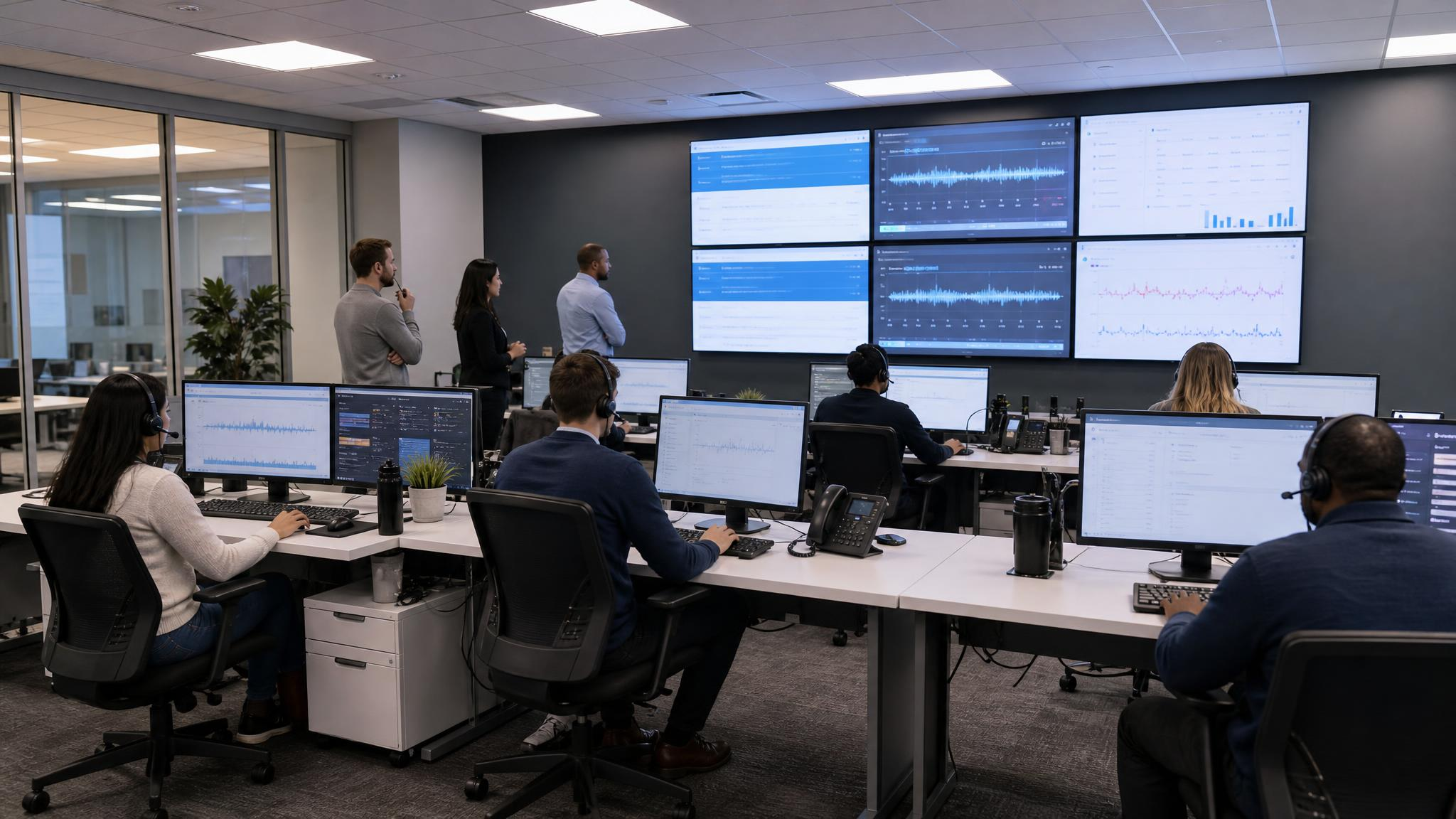
Microsoft has released a streaming transcription model and two text-to-speech systems in Microsoft Foundry, targeting voice applications that need to listen, reason and respond without the long pauses that make automated conversations feel mechanical.
MAI-Transcribe-2-Streaming produces early partial text within hundreds of milliseconds, then revises the transcript as more audio arrives and commits a stable result after the speaker finishes. Microsoft says it supports 60 languages with continuous language detection.
The company also introduced MAI-Voice-2.1, designed for expressive multilingual speech, and MAI-Voice-2.1-Flash, a lower-latency version aimed at responsive, high-volume use. Together they cover the input and output sides of a real-time voice agent.
Microsoft is offering the streaming transcription model at an introductory price of 54 cents per hour of audio through the end of the year. Actual application cost will also include language-model reasoning, tool calls, generated speech and the infrastructure holding an open session.
What Changed
Partial transcripts matter because a voice agent can begin planning before a speaker has completed a sentence. That shortens response time, but it creates a risk that the system acts on a hypothesis later corrected by additional words.
Applications should therefore distinguish reversible preparation from external action. An agent may retrieve information while the user speaks, but it should not submit an order or alter a record until the relevant instruction is stable and confirmed.
Microsoft cites the Artificial Analysis streaming leaderboard, where its model ranked first on final and partial accuracy at the time measured. Leaderboards are useful, though customer audio will contain accents, jargon, overlapping speakers and poor microphones that differ from benchmark conditions.

Continuous language detection can help multilingual calls in which speakers switch languages, but it also complicates evaluation. Teams need to test names, addresses, account numbers and specialized terms because a low average word-error rate can hide failures on the information that matters most.
The two voice models give developers a quality and speed tradeoff. A customer-service agent may prioritize a fast first response, while a narrated application may accept more latency for expressive pacing and pronunciation.
Synthetic speech also needs clear disclosure. A natural voice can reduce friction, but users should know when they are interacting with an automated system and how recordings or transcripts will be retained.
A model release is now a systems event rather than a leaderboard update. Access terms, context handling, tool reliability, latency and safeguards determine whether a capability can be used in production.
Provider benchmarks are useful evidence, but they are not neutral audits. Customers should recreate representative tasks, preserve failed cases and compare accepted outcomes rather than isolated scores.
Pricing also changes behavior. Lower inference cost makes verification and repeated attempts more affordable, while long contexts and agent loops can still turn an inexpensive token rate into a costly workflow.
The NIST AI Risk Management Framework gives buyers a shared vocabulary for mapping model risks, measuring controls and documenting who accepts the remaining exposure before deployment.
The Stanford AI Index offers a broader comparison of capability, investment, regulation and adoption, which helps place a provider's launch claims inside the direction of the wider market.
The product question is whether a new capability can become dependable infrastructure. That requires clear ownership, stable interfaces, usable administration and a failure path that ordinary teams can understand before the system reaches consequential work.
The Evidence To Watch
The release strengthens Microsoft's position at the model layer of Foundry, where developers can assemble speech, reasoning and tools under one cloud account. That convenience reduces integration work while increasing the importance of portability and transparent billing.
Voice systems create a persistent privacy boundary because microphones capture background speech and incidental information. Applications should limit collection, expose recording state and avoid retaining raw audio longer than the use case requires.
Latency measurements need to cover the complete turn. Fast transcription does not produce a responsive conversation if tool calls, retrieval or speech synthesis add seconds after the user stops.
Restricted access changes how a model can be evaluated. Selected partners may see more capable configurations, longer context limits or stronger tool integrations than the public product, so outside observers need precise disclosure about which system produced a reported result. Without that detail, a launch can create one reputation around several materially different services.
A large generation window also shifts the human problem from prompting to supervision. Reviewers need navigable intermediate states, source references and a way to stop or redirect work before an incorrect premise spreads through hundreds of pages. Length is useful only when the interface lets people inspect the reasoning process without rereading the entire artifact after every change.
Model providers increasingly treat post-deployment telemetry as part of safety engineering. That can reveal repeated failures and emerging abuse, but it requires clear limits on what the provider can inspect, how long records remain available and whether customers can obtain the same evidence during an incident. Monitoring that is invisible to the customer cannot serve as a complete audit trail.
Long-running agents also complicate performance measurement. A model may complete more tasks by spending more time, making more calls and using additional tools. Fair comparisons should disclose the total compute, wall-clock time, intervention count and number of failed attempts behind a successful result rather than treating the final answer as if it came from one clean execution.
The access policy will influence the developer ecosystem around the model. Early partners can build evaluation suites, connectors and operational knowledge before broad release, while smaller companies wait without knowing whether their product plans will be supported. Providers should publish stable milestones and compatibility expectations when a phased rollout lasts longer than a short safety review.
Government pre-release testing adds another evaluator, but it does not replace customer-specific assurance. A public agency may focus on national-security capabilities, while a bank, hospital or software company needs evidence about its own records, workflows and failure costs. The two reviews can reinforce each other only when their scopes and limitations are understood.
The eventual measure of the release will be the gap between controlled access and ordinary use. If safeguards survive broader prompting, unfamiliar tools and weaker operational discipline, the phased strategy will have produced useful evidence. If restrictions merely postpone the same failures, the launch will show that access control cannot substitute for a robust product architecture.
Interruption handling is equally important. People correct themselves, talk over an agent and change direction. A useful system needs to stop speaking, revise its plan and preserve enough context to continue without repeating the exchange.
The model should also expose confidence in a form the application can use. Low-confidence names or numbers can trigger confirmation, while routine phrases can pass without forcing the user through constant verification.
Microsoft's release shows that voice-agent competition is moving from impressive demos toward the timing and accuracy of ordinary conversation. The winners will be systems that remain understandable when speech is messy, not those that sound most human in a prepared clip.
Microsoft Launches Real-Time Transcription and Voice Models for AI Agents also changes the practical sequence of decisions. Organizations need to establish what is known, what came from the reporting source and what remains a provider or official claim before they turn the development into procurement, policy or operational guidance.
The immediate test for MAI-Transcribe-2-Streaming is not whether the idea sounds plausible. It is whether another team can reproduce the result or verify the reported conduct using preserved records, defined conditions and a comparison with the process that existed before the change.
Microsoft AI introduces dependencies that are easy to miss during a launch cycle. Identity, data access, model versions, infrastructure capacity and human approval can each determine the outcome even when the visible product appears to be one integrated service.
A useful evaluation should include failed attempts and interventions. If specialists repeatedly correct the system, rebuild context or reverse actions, the apparent speed of voice agents may reflect work moved to a less visible part of the organization rather than work eliminated.
The commercial and institutional incentives point in different directions. Providers benefit from rapid adoption and broad claims, while customers and regulators need stable definitions, comparable evidence and enough time to examine conduct outside the conditions selected for a demonstration.
That tension does not require stopping useful experimentation. It argues for bounded trials in which authority is narrow, logs remain available and the organization has already decided which result would justify expansion, revision or suspension.
The human role should be specified rather than described as oversight in the abstract. Reviewers need time, relevant evidence and authority to reject the recommendation. A person who sees only the final output cannot reliably detect an upstream data or permission failure.
Costs should be counted at the completed-task level. Inference, retries, connected tools, specialist review, security controls and incident recovery all contribute to the price of a dependable outcome, even when the headline model or software rate appears low.
The record also needs to survive a vendor update. Teams should retain the model and policy version, evaluation set, accepted exceptions and the reason a deployment was approved so that later performance can be compared with the system decision-makers actually examined.
Version changes need formal control. Organizations should record the exact model, endpoint and configuration used for a decision, then retest when any of those components change.
A phased release can reduce exposure while a provider gathers evidence. It can also create a privileged market in which selected partners learn the system months before ordinary developers can evaluate it.
The durable advantage will come from consistent work under imperfect conditions, not a polished result produced with ideal prompts and unrestricted time.
OWASP's guidance for generative AI applications is also relevant once a model receives tools or private data, because application-level permissions and prompt injection can overwhelm model-level safeguards.
ISO artificial intelligence standards provide a common reference for management systems and risk controls when model behavior has to be governed across suppliers and jurisdictions.
The first implementation discipline is a clear baseline. Teams should record how the work is performed today, how long it takes, which errors occur and which outcomes matter before introducing a new system.
Evaluation should include incomplete instructions, unusual inputs and changing conditions. Prepared demonstrations remove precisely the ambiguity that production systems are expected to handle.
Human review has to be designed around limited attention. Asking a person to approve a constant stream of routine outputs produces click-through behavior rather than meaningful oversight.
Data lineage deserves equal scrutiny. A polished result can be assembled from stale, incomplete or incorrectly joined records, so important claims need traceable sources and update times.
Procurement should cover retention, subcontractors, model changes, export rights and incident notice. Those terms determine whether a pilot can become governed infrastructure.
Metrics should include abandoned tasks, manual takeovers, permission denials and corrected outputs. Those events show where uncertainty enters the workflow even when no public incident occurs.
Competition can improve price and quality, but it can also make restraint look like weakness. Release processes need room to narrow or delay a feature when the evidence does not support wider use.
Workforce effects should be measured across the process. Automation can remove one repetitive step while creating review, exception handling and customer communication somewhere else.
Organizations should preserve an exit path. Model portability, documented workflows and exportable records reduce the risk that an experimental decision becomes an irreversible dependency.
The near-term evidence will come from customer deployments, independent testing and the handling of failures. Those signals reveal strategy more clearly than a launch-stage claim.
A useful deployment plan separates technical success from organizational readiness. The system may perform a task in testing while the institution still lacks an owner, an incident process or authority to suspend it. Launch approval should require both forms of evidence because a reliable component can still produce harm inside an unmanaged workflow.
Independent review is strongest when evaluators can reproduce the relevant conditions. Aggregate scores and selected examples are not enough for high-consequence claims. Reviewers need model or hardware versions, tool settings, input classes, intervention rules and the definition of success, along with enough failed cases to understand where the boundary lies.
Communication after failure deserves advance design. Customers, workers and regulators need different information at different speeds, but all of them benefit from a consistent factual record. Teams should decide who confirms an event, who can speak publicly and how corrections will be issued before commercial pressure makes those choices harder.
The final decision should remain reversible. Organizations can limit scope, keep a manual path and set a date for reassessment rather than treating adoption as a permanent endorsement. Reversibility turns uncertainty into a managed condition and gives leaders room to respond when new evidence changes the balance of benefit and risk.
The significance of MAI-Transcribe-2-Streaming will be settled after the announcement cycle. The durable measure is whether the evidence improves, the controls survive pressure and the organizations involved remain willing to explain decisions when performance and responsibility pull in different directions.
Topics: MAI-Transcribe-2-Streaming, Microsoft AI, voice agents, speech recognition, Microsoft Foundry